Blog

  • I Built Three Production Apps with AI — And Outpaced the Custom Developers

    I Built Three Production Apps with AI — And Outpaced the Custom Developers

    There’s an unspoken hierarchy in software development.

    Custom developers — the people writing backends in Go, architecting databases, configuring CI/CD pipelines — occupy a certain tier of technical credibility. And then there are people like me: WordPress developers, no-code builders, AI-assisted developers. The people who, in certain rooms, feel like they need to justify their presence at the table.

    I’ve felt that. More than once.

    This is the story of a project that changed how I think about that hierarchy — and what happened when a WordPress and AI developer was handed one of the most complex frontend builds of his career.


    How It Started

    When Monkey & River and Momentum began planning their annual hackathon, they needed a platform. Not a tweaked version of an existing tool. A purpose-built system capable of managing roughly 700 student candidates through registration, team formation, judging, and final results — with an admin team that needed granular control over every stage of the process.

    Three separate applications. A custom Go/Gin backend. PostgreSQL. Real infrastructure, real scale, real stakes.

    I heard about the project and I was immediately excited. Not nervous — excited. Because I knew exactly what tool could deliver this, and I knew it because I’d been using it for months.

    I recommended Lovable.

    It was actually my suggestion that led Monkey & River to choose Lovable for the frontend. I believed in what the platform could do, and I was confident I could deliver. The development lead didn’t have the same depth of Lovable experience, which led to a natural split: I would own all three frontend applications, while Thomas and his team built the backend and infrastructure.

    It was, on paper, a clean division of responsibility.

    In practice, it was about to get considerably more interesting.


    Building Three Apps at Once

    The scope was significant. Three applications, each with their own authentication flows, their own user roles, their own UX logic — but sharing a design language, a component library, and a consistent experience across all of them.

    The Admin Portal was the operational heart of the platform. Eight full phases of functionality: participant management with CSV import and export, a dynamic stage builder that let the MnR team configure the entire hackathon pipeline, team management, judge management, a configurable scoring dashboard with a live leaderboard, a communications module for bulk email, an audit log, and full user management with role-based access control. Dark mode. Notification flows. Scroll restoration. The kind of detail that separates a polished product from a functional one.

    The Participant Portal was the student-facing application — the thing 700 candidates would actually use. Mobile-first, responsive, and built around a dynamic stage system that rendered form fields on the fly based on whatever the admin team had configured. No hardcoded forms. No rigid templates. The portal adapted in real time to the shape of the hackathon as the MnR team defined it.

    The Bulk Email Tool was a standalone internal application for sending branded bulk emails to applicants. A block-based email composer, CSV recipient management, SendGrid integration via Supabase Edge Function, and full send history. Small in scope relative to the other two, but critical to the communications workflow.

    One of the things I’m most proud of from this phase of the project is how I approached the consistency problem. When you’re building three separate applications that need to feel like one coherent system, the temptation is to rebuild everything from scratch in each app. Instead, I leaned into Lovable’s project knowledge — reusing components, navigation patterns, and styling decisions across all three applications. The result was a suite of tools that felt designed together, not assembled separately.

    I was building fast. And it looked good.


    The Week Everything Got Harder

    Then the backend team said they were ready to connect.

    This is where I need to be honest about something. My background is in WordPress and AI-assisted development. I am comfortable in that world. I know how it works, I know the tools, and I know my own capabilities within it.

    Docker Desktop was not part of that world.

    Neither was Bruno, or CORS configuration, or working through authentication pepper mismatches, or debugging port conflicts between a local Go server and a React frontend. These were not things I had done before. And they were now things I needed to do — alone, without a manual, on a timeline.

    I genuinely enjoyed it.

    I know that might sound strange. But there’s something about being dropped into unfamiliar territory with a real problem to solve that makes the work feel meaningful in a way that familiar tasks don’t. Every obstacle I cleared — getting the backend running locally for the first time, fixing the CORS configuration, working out why the auth flow wasn’t returning the right tokens — was a small proof that I could figure things out I’d never done before.

    This is where Claude Code became essential.

    I’d been using Claude as a development collaborator for a while at this point. But Claude Code — working directly in the codebase, making changes in context — was a different kind of tool. I used it to integrate the real API into the admin portal: fixing the two-step login and workspace selection flow, unwrapping the response envelopes the backend was returning, mapping between the frontend’s camelCase field names and the backend’s snake_case, configuring the URL prefixes. Changes that, done manually without deep Go and TypeScript experience, would have taken days. Done with Claude Code, they took hours.

    I pushed everything to GitHub, coordinated with Thomas on the backend fixes that my integration work had surfaced — CORS headers, role claims, viewmodel refactoring — and kept moving.


    The Moment That Mattered

    There’s a specific memory from this project that I keep coming back to.

    The backend team had been working on their side for weeks. Solid engineers, building real infrastructure, doing genuinely complex work. And then there was me — the WordPress developer, the AI builder — showing up to sprint reviews with fully functional, aesthetically polished applications that were ready to connect.

    I don’t say this to diminish what the backend team did. Their work is the foundation everything runs on. But in that room, in those moments, I felt something shift.

    As a WordPress and AI developer, I’ve often felt like I occupy a secondary tier. Like the “real” developers are the ones writing custom code from scratch, and I’m the person who makes things pretty and functional but isn’t quite in the same category. This project quietly dismantled that feeling.

    I delivered three production-quality applications — with authentication, role management, dynamic data rendering, responsive design, dark mode, and a polished UI — in a fraction of the time that a traditional frontend development approach would have required. The tool I used was AI-assisted. The speed was real. The output was real. And the impact was real.

    That’s not a shortcut. That’s a different way of working.


    What Lovable Actually Is

    I want to address something directly, because I think there’s still a lot of misunderstanding about what tools like Lovable are and what they’re not.

    Lovable is not a drag-and-drop website builder. It’s not a template platform. It’s not something you hand to someone with no technical background and expect production software to come out the other side.

    What it is, in my experience, is a React and TypeScript development environment that collapses the distance between intention and implementation. When I describe a component, a flow, or a feature, Lovable generates the code. When I review it and find something that needs changing, I refine it. When it needs to connect to a real API — as this project eventually did — that’s where Claude Code, GitHub, and genuine development knowledge come in.

    The stack is real: React, TypeScript, Tailwind, ShadCN. The code is real. The applications it produces are production-quality. What changes is the speed at which a skilled developer can move from problem to solution.

    That speed matters. In a world where development timelines are one of the biggest constraints on what gets built, the ability to deliver in days what used to take weeks is not a minor advantage. It’s a fundamental shift in what’s possible.


    What I’m Taking Away

    The MnR Hackathon Platform isn’t finished yet. The backend team is still completing the remaining endpoints — teams, scoring, communications, audit log — and once those are ready, the frontend mock data gets replaced with live API responses and the platform goes live for the next annual event.

    But the frontend is done. Three applications, built by one developer, using AI tools, delivered at a pace that surprised everyone including me.

    Here’s what I know now that I didn’t fully know before this project:

    The hierarchy I described at the start of this post — the one where custom developers occupy a tier above AI-assisted developers — is a hierarchy built on assumptions that are becoming less true every month. The question isn’t what tools you use. It’s what you can deliver, and how fast, and how well.

    On this project, I recommended the right tool, built the right applications, solved problems I’d never encountered before, and delivered something the whole team could be proud of.

    That’s the job. Whatever tools it takes.

  • How I Used AI to Build a Full WordPress Theme from Scratch

    How I Used AI to Build a Full WordPress Theme from Scratch

    There’s a moment in most projects where the scope hits you. Where the thing someone wants collides with the reality of what it costs to build it, and the room goes quiet.

    I had that moment not long ago, sitting with a quote for a client who had come to us with an idea for a custom e-learning platform. A full LMS. Live video classes, an interactive whiteboard, scheduling, attendance tracking, multi-role dashboards, multilingual support, resource management, and a mobile app to tie it all together. The kind of product that, done properly, is a serious piece of software.

    The development estimate came to 390 hours. The design estimate — research, UX flows, wireframes, branding, a full design system, high-fidelity UI, prototyping, and handoff — added another 120 to 175 hours on top.

    We’re talking somewhere north of 500 hours of professional work. At agency rates, that’s a number that makes most clients’ eyes water.

    The client couldn’t believe it. They’d had a vision in their head, a problem they wanted to solve, and no real frame of reference for what it would take to build the solution properly. They didn’t accept either quote — not the development one, and not the design one. Not because the quotes were wrong. But the true cost of custom software is something most people have never had to confront before.

    They walked away. But they left me with a question I couldn’t stop thinking about.

    What if WordPress could do this?


    The Premise

    I want to be upfront about something: I’m a WordPress developer. I know the platform well. I know what it can do, and I know what it struggles with. And when I looked at the requirements for this client’s platform, my instinct was that a custom WordPress theme — built properly, from scratch — could hit most of the brief at a fraction of the cost and timeline.

    But I wanted to test that instinct. Not just sketch something out or throw together a page builder demo. I wanted to actually build it. A production-quality LMS theme, coded by hand, with real functionality — and I wanted to do it using AI as my development partner.

    The result was ApexLearn.


    What I Actually Built

    ApexLearn is a fully custom WordPress LMS theme. No page builder. No starter theme. No plugins doing the heavy lifting. Every line of PHP, CSS, and JavaScript was written deliberately — with Claude as my collaborator throughout.

    Here’s what the finished theme includes:

    Custom Post Types and Taxonomiescourse, instructor, and lesson CPTs registered entirely in code, with course_category and course_level taxonomies powering a dynamic course catalogue.

    AJAX Course Filtering — live filtering by category and level with no page reload, a PHP AJAX handler secured with nonces, and GSAP stagger animations on the returned cards.

    Dynamic Single Course Template — hero pulled from the featured image, real instructor bio and photo loaded from a linked instructor CPT, related courses queried by matching taxonomy, animated progress indicators, and a sticky enrol sidebar.

    Simulated Enrolment Flow — a fully designed multi-step checkout modal with personal details, card fields, and a success state, built to demonstrate the UX without real payment processing.

    Interactive Student Dashboard — five-panel sidebar navigation, animated metric counters, progress bars with CSS transition animations, tabbed course lists, an expandable activity feed, and functional settings toggles.

    Performance and Polish — page transition fades, sticky navigation with hide-on-scroll behaviour, button ripple effects, scroll-triggered section reveals via IntersectionObserver, and image lazy loading.

    Full Responsive Design — mobile-optimised across three breakpoints, with a hamburger nav, a catalogue filter drawer, and a dashboard sidebar that converts to a horizontal scrollable tab strip on small screens.

    Seven-page templates. A complete design system built on CSS custom properties. GSAP animations throughout. And a 404 page, because the details matter.


    How the AI Collaboration Actually Worked

    I want to be honest about this, because I think there’s a lot of noise right now about what AI can and can’t do in development — and most of it misses the point.

    I didn’t type “build me an LMS” and watch a theme appear. That’s not how it works, and that’s not what I wanted anyway.

    What I did was bring a clear vision and a structured approach. I communicated how I wanted things to be architected. I worked through design iterations — describing what I wanted, reviewing what came back, refining until it felt right. Once the design direction was locked, the theme file was generated as a starting point. I uploaded it to LocalWP, opened Visual Studio Code, and continued building from there using Claude Code.

    The process felt less like using a tool and more like working with a capable developer who happened to be available at 11 pm when I was trying to figure out why a GSAP animation wasn’t firing correctly on scroll. I’d describe the problem, we’d work through it, and I’d implement the fix. When I wanted to add a feature, I’d explain the behaviour I was after, and we’d figure out the cleanest way to build it.

    The design system came out of that kind of back-and-forth. Three typefaces — Cormorant Garamond, Source Sans 3, and a mono stack. A teal/green brand palette. Generous whitespace, subtle shadows, a premium corporate feel that was informed by the client brief but elevated by the iteration process.


    Where It Pushed Back

    I said I’d be honest, so here it is: AI didn’t make everything easy.

    There were moments where the generated code needed significant reworking. Where a suggested approach worked in isolation, but broke something else in the theme. Where I had to understand what was happening well enough to fix it, not just copy and paste a solution.

    This is the part that I think gets lost in the “AI is going to replace developers” conversation. The AI made me faster. It reduced the friction of getting from idea to implementation. It handled a lot of the manual nuance that used to eat hours — the boilerplate, the syntax checking, the “what’s the WordPress function for this again” moments.

    But it didn’t replace the need to think. To the architect. To make decisions about how things should be structured and why. The knowledge I’ve built over years of WordPress development wasn’t made redundant by AI — it was what allowed me to use AI effectively. Without understanding the WordPress template hierarchy, CPT registration, and how AJAX handlers work, I wouldn’t have known whether the generated code was good or just plausible-looking.

    AI is a force multiplier. It’s not a substitute.


    The Numbers That Matter

    Let’s go back to that original quote for a moment.

    The custom software estimate was 390 hours of development and up to 175 hours of design. At modest agency rates, that’s a project measured in hundreds of thousands of rands before you’ve written a line of code.

    ApexLearn — a theme that covers a substantial portion of the core brief — was built by one developer, working with AI, in a fraction of that time. It’s not a pixel-perfect match to every feature on the spec sheet. Live video integration, real payment processing, and multi-tenant architecture are genuinely hard problems that custom software handles better. But the core experience — the course catalogue, the student dashboard, the enrolment flow, the instructor profiles — all of it works, all of it looks premium, and all of it was built without a team.

    That gap is significant. And it’s only going to get more significant as AI tools improve.


    My Honest Verdict

    I’ll say it plainly: I’m genuinely impressed by what’s possible.

    Do I think AI is going to take my job? Not yet. Not soon. The craft of development — the architectural decisions, the client communication, the problem-solving under constraint — still requires a human who knows what they’re doing. What AI has done is compress the timeline between having an idea and having something real. It’s removed a lot of the friction that used to make ambitious solo projects impractical.

    For developers who are willing to adapt, that’s not a threat. It’s an enormous advantage.

    ApexLearn started as a question: Can WordPress meet these requirements? The answer, built line by line with AI at my side, was a convincing yes.

    The client who inspired it never saw the finished product. But the next client who comes to me with an ambitious brief will.


    What This Means for the Industry

    If you’re a developer reading this, here’s what I’d encourage you to think about: the developers who will struggle in an AI-assisted world aren’t the ones who know too much. They’re the ones who refuse to adapt.

    AI doesn’t reward ignorance. It rewards people who understand their craft well enough to direct it, review it, and improve on what it produces. The bar for what one person can build has moved — significantly — and that creates opportunities for developers who are willing to work with the tools rather than against them.

    I built a production-quality LMS theme by myself, using AI as a collaborator. That’s not a party trick. That’s a genuine shift in what’s possible.

    And I’m just getting started.

  • From Lab Coat to Laptop – My Unexpected Journey into Web Development

    From Lab Coat to Laptop – My Unexpected Journey into Web Development

    There’s a version of this story where everything goes to plan. Where I map out a career, follow the steps, and arrive at my destination right on schedule. This isn’t that story. This is the version where a global pandemic, a chili business, a funeral, and one very awkward doorbell moment somehow conspired to change the entire direction of my life.


    The Unexpected Start

    When I finished school, I didn’t have a grand plan. My mother worked at Ampath — one of South Africa’s largest pathology laboratories — and when she mentioned a contract role was available in the administrative department, I applied. I wasn’t thinking about careers or futures. I just needed a job.

    I got the position. It was supposed to last a month.

    Nearly two years later, I was still there.

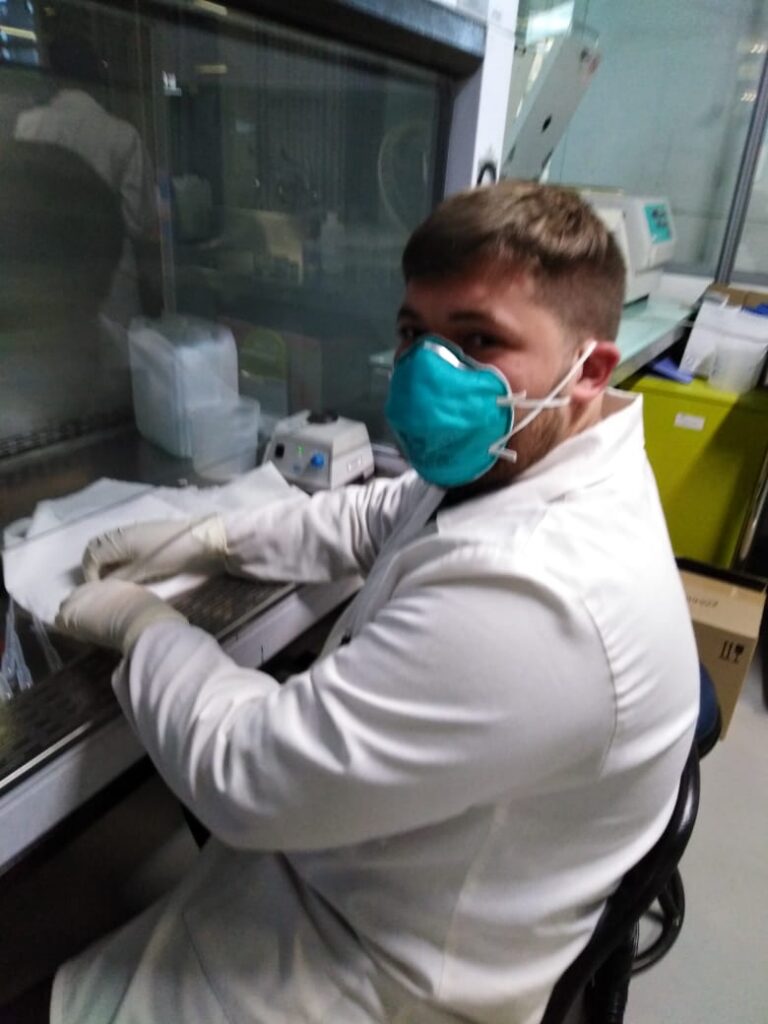
    It turned out I was good at it. I enjoyed the pace, the precision, the environment. And when the opportunity came to study for my immunology qualification, I grabbed it without hesitation. That qualification changed everything. It opened doors within Ampath I hadn’t even known existed, and over the following years I climbed from administrative assistant to medical technician.

    When a colleague on the immunology night team went on maternity leave, I stepped in to cover for a few months. I expected to count down the days until I could return to normal hours. Instead, I discovered something unexpected: I actually liked working nights. The quiet. The focus. The sense of getting something done while the rest of the world slept.

    So when a permanent night shift position opened in the molecular lab, I applied.

    I got it. And then, about three weeks after I started, the world ended.


    Testing in a Pandemic

    March 2020. COVID-19 had arrived in South Africa.

    The molecular lab was responsible for processing COVID samples. Suddenly, the lab that had been steady and manageable became one of the most important places in the country. The testing demand was overwhelming. Shifts stretched. The work was relentless. But something was grounding about it too — a sense that the work we were doing mattered in a way that was impossible to ignore.

    I won’t pretend it was easy. The pandemic was terrifying for everyone, and we were in the middle of it in a very literal sense — handling the samples, running the tests, waiting for the results. But I showed up, night after night, and I did the job.

    Outside the lab walls, the economy was collapsing.


    A Chili Business and a Website

    My father lost his job.

    Like millions of South Africans during that period, he was a casualty of an economy that simply stopped. I wanted to help. We put our heads together and came up with something scrappy and honest: a small business selling chili products. Pickled chilies, spice blends, the kind of thing you make from scratch and sell with heart. We called it something simple and got to work.

    We made a few sales. Enough to feel like something. Not enough to make a real difference.

    It didn’t take long to realise the problem. Nobody could find us. We had a product and no presence. And that’s when I said something that would, without either of us knowing it at the time, completely change the course of my life.

    “We need a website.”

    I had never built a website. I had never written a line of code. I didn’t know what WordPress was, what hosting meant, or what a domain even did. What I did have was a computer, an internet connection, and the same stubbornness that had taken me from admin assistant to medical technician.

    I started watching YouTube tutorials. Then more YouTube tutorials. Then, when something didn’t work, more tutorials. It was slow, messy, and completely absorbing. Every time I hit a wall, I’d find a video that showed me how to climb it. Every time I got something working, I felt a kind of satisfaction that I hadn’t felt in a long time.

    Several weeks later, the website was done.

    By the time I finished it, my father had passed away.


    Something Worth Keeping

    Grief does strange things to your sense of direction. In the weeks after losing my dad, I found myself returning to the website — not to update it, but just to look at it. Something about building it had felt meaningful. Not because it had saved the business (it hadn’t), and not because it had saved my father (nothing could). But because I had made something that hadn’t existed before. I had learned something entirely new, in my own time, from nothing.

    I wanted to keep doing that.

    I started offering to build websites for friends and family. Small one-page sites at first. Then slightly more complex ones. I wasn’t charging much — sometimes nothing at all — but I was building a body of work and, more importantly, building confidence. By the time I had eight sites under my belt, I was starting to think that this wasn’t just a hobby.

    Maybe this could be a career.


    The Doorbell Moment

    One afternoon, driving home from a night shift at Ampath, I passed a building with a sign outside: Monkey and River. I didn’t know what they did. The name stuck with me.

    When I got home, I looked them up.

    Software development. Websites. Digital products. And right there on their site — built on WordPress.

    I remember my exact thought: “Wow. They use WordPress to sell websites.”

    I was spectacularly wrong about what that meant. I had no idea that what I had been teaching myself from YouTube tutorials barely scratched the surface of what professional WordPress development involved. But I didn’t know what I didn’t know, and in that moment, that ignorance felt like courage.

    I wanted to work there. So I went to LinkedIn to find an application process.

    Nothing.

    I checked their website for a careers page.

    Nothing.

    I sat with this for a day or two. And then I made the kind of decision that, in retrospect, sounds either very brave or very foolish depending on how it turns out.

    I drove to their office. I walked up to the gate. And I rang the doorbell.

    I had spent days on my CV. Not a standard CV — I had designed it to look like an old computer terminal. Green text on a black background. Styled like a command-line interface. Looking back, I cannot believe it worked. But I handed it to the first person who came to the gate, thanked them for their time, and drove home not knowing if I’d ever hear from them again.

    Two weeks later, my phone rang.


    The Interview I Wasn’t Ready For

    I prepared obsessively. I spent days learning every buzzword I thought might come up. UI/UX. Agile methodology. Quality assurance. Responsive design. I rehearsed answers to questions I imagined they might ask, pacing around my flat mouthing explanations of things I half understood.

    None of it helped.

    I sat in that interview feeling completely out of my depth. The questions were deeper than I’d prepared for. The technical bar was higher than I’d expected. There were moments where I had to simply admit I didn’t know something — and there’s nothing more uncomfortable than doing that while trying to convince someone to hire you.

    And then, at the end of the interview, they offered me the job.

    The salary was significantly less than what I was earning at Ampath. For someone who had spent years building up experience, qualifications, and a stable income in a completely different field, saying yes meant starting over. But I knew, sitting in that room, that this was the industry I wanted to be in. So I said yes.


    What They Told Me a Year Later

    About twelve months into the job, someone at Monkey and River told me something I’ve never forgotten.

    They said I got the job for two reasons.

    The first: I was the only person in the company’s history to physically walk up to the front door and hand in a CV. In an industry where everything happens online, that stood out in a way that no LinkedIn application could.

    The second: for my level of experience at the time, my website was genuinely impressive.

    I’ve thought about that a lot since. The website I built to help sell my dad’s chili products — the one I taught myself from YouTube tutorials while working night shifts at a molecular lab during a global pandemic — that website was what got my foot in the door of a career I now love.


    What I’d Tell Anyone Thinking About Making a Change

    I’m not going to tell you that career changes are easy. They’re not. Mine cost me a pay cut, years of uncertainty, and more hours of self-directed learning than I can count. It also happened in the shadow of real loss, which made everything feel both more urgent and more fragile at the same time.

    But here’s what I know: the skills that got me through seven years in a laboratory — attention to detail, following process, troubleshooting under pressure, showing up when it’s hard — turned out to be exactly the skills that made me good at this. The industry changed. The tools changed. The mindset didn’t.

    If you’re sitting somewhere right now thinking about a change, here’s the most honest advice I can give you:

    Build something. Anything. A website for your mum’s business. A landing page for a product that might not exist yet. A portfolio of one. Learn from YouTube. Learn from doing. And when you can’t find the application form, ring the doorbell.

    The worst they can do is not answer.