There’s a version of this story where everything goes to plan. Where I map out a career, follow the steps, and arrive at my destination right on schedule. This isn’t that story. This is the version where a global pandemic, a chili business, a funeral, and one very awkward doorbell moment somehow conspired to change the entire direction of my life.
The Unexpected Start
When I finished school, I didn’t have a grand plan. My mother worked at Ampath — one of South Africa’s largest pathology laboratories — and when she mentioned a contract role was available in the administrative department, I applied. I wasn’t thinking about careers or futures. I just needed a job.
I got the position. It was supposed to last a month.
Nearly two years later, I was still there.
It turned out I was good at it. I enjoyed the pace, the precision, the environment. And when the opportunity came to study for my immunology qualification, I grabbed it without hesitation. That qualification changed everything. It opened doors within Ampath I hadn’t even known existed, and over the following years I climbed from administrative assistant to medical technician.
When a colleague on the immunology night team went on maternity leave, I stepped in to cover for a few months. I expected to count down the days until I could return to normal hours. Instead, I discovered something unexpected: I actually liked working nights. The quiet. The focus. The sense of getting something done while the rest of the world slept.
So when a permanent night shift position opened in the molecular lab, I applied.
I got it. And then, about three weeks after I started, the world ended.
Testing in a Pandemic
March 2020. COVID-19 had arrived in South Africa.
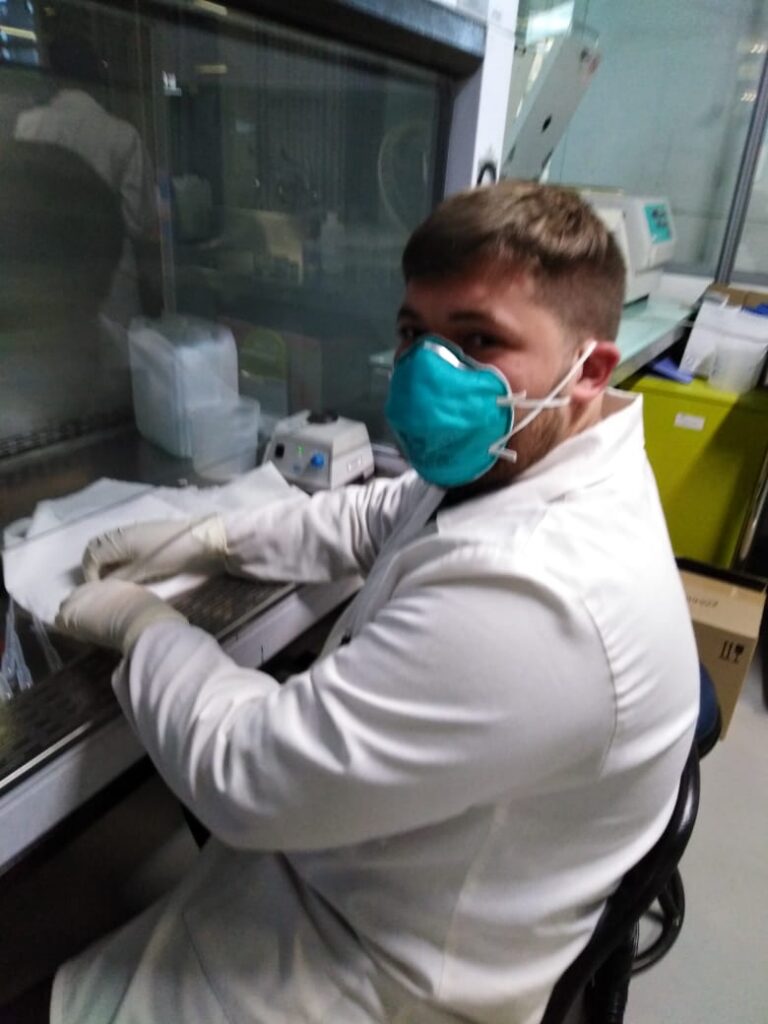
The molecular lab was responsible for processing COVID samples. Suddenly, the lab that had been steady and manageable became one of the most important places in the country. The testing demand was overwhelming. Shifts stretched. The work was relentless. But something was grounding about it too — a sense that the work we were doing mattered in a way that was impossible to ignore.
I won’t pretend it was easy. The pandemic was terrifying for everyone, and we were in the middle of it in a very literal sense — handling the samples, running the tests, waiting for the results. But I showed up, night after night, and I did the job.
Outside the lab walls, the economy was collapsing.
A Chili Business and a Website
My father lost his job.
Like millions of South Africans during that period, he was a casualty of an economy that simply stopped. I wanted to help. We put our heads together and came up with something scrappy and honest: a small business selling chili products. Pickled chilies, spice blends, the kind of thing you make from scratch and sell with heart. We called it something simple and got to work.
We made a few sales. Enough to feel like something. Not enough to make a real difference.
It didn’t take long to realise the problem. Nobody could find us. We had a product and no presence. And that’s when I said something that would, without either of us knowing it at the time, completely change the course of my life.
“We need a website.”
I had never built a website. I had never written a line of code. I didn’t know what WordPress was, what hosting meant, or what a domain even did. What I did have was a computer, an internet connection, and the same stubbornness that had taken me from admin assistant to medical technician.
I started watching YouTube tutorials. Then more YouTube tutorials. Then, when something didn’t work, more tutorials. It was slow, messy, and completely absorbing. Every time I hit a wall, I’d find a video that showed me how to climb it. Every time I got something working, I felt a kind of satisfaction that I hadn’t felt in a long time.
Several weeks later, the website was done.
By the time I finished it, my father had passed away.
Something Worth Keeping
Grief does strange things to your sense of direction. In the weeks after losing my dad, I found myself returning to the website — not to update it, but just to look at it. Something about building it had felt meaningful. Not because it had saved the business (it hadn’t), and not because it had saved my father (nothing could). But because I had made something that hadn’t existed before. I had learned something entirely new, in my own time, from nothing.
I wanted to keep doing that.
I started offering to build websites for friends and family. Small one-page sites at first. Then slightly more complex ones. I wasn’t charging much — sometimes nothing at all — but I was building a body of work and, more importantly, building confidence. By the time I had eight sites under my belt, I was starting to think that this wasn’t just a hobby.
Maybe this could be a career.
The Doorbell Moment
One afternoon, driving home from a night shift at Ampath, I passed a building with a sign outside: Monkey and River. I didn’t know what they did. The name stuck with me.
When I got home, I looked them up.
Software development. Websites. Digital products. And right there on their site — built on WordPress.
I remember my exact thought: “Wow. They use WordPress to sell websites.”
I was spectacularly wrong about what that meant. I had no idea that what I had been teaching myself from YouTube tutorials barely scratched the surface of what professional WordPress development involved. But I didn’t know what I didn’t know, and in that moment, that ignorance felt like courage.
I wanted to work there. So I went to LinkedIn to find an application process.
Nothing.
I checked their website for a careers page.
Nothing.
I sat with this for a day or two. And then I made the kind of decision that, in retrospect, sounds either very brave or very foolish depending on how it turns out.
I drove to their office. I walked up to the gate. And I rang the doorbell.
I had spent days on my CV. Not a standard CV — I had designed it to look like an old computer terminal. Green text on a black background. Styled like a command-line interface. Looking back, I cannot believe it worked. But I handed it to the first person who came to the gate, thanked them for their time, and drove home not knowing if I’d ever hear from them again.
Two weeks later, my phone rang.
The Interview I Wasn’t Ready For
I prepared obsessively. I spent days learning every buzzword I thought might come up. UI/UX. Agile methodology. Quality assurance. Responsive design. I rehearsed answers to questions I imagined they might ask, pacing around my flat mouthing explanations of things I half understood.
None of it helped.
I sat in that interview feeling completely out of my depth. The questions were deeper than I’d prepared for. The technical bar was higher than I’d expected. There were moments where I had to simply admit I didn’t know something — and there’s nothing more uncomfortable than doing that while trying to convince someone to hire you.
And then, at the end of the interview, they offered me the job.
The salary was significantly less than what I was earning at Ampath. For someone who had spent years building up experience, qualifications, and a stable income in a completely different field, saying yes meant starting over. But I knew, sitting in that room, that this was the industry I wanted to be in. So I said yes.
What They Told Me a Year Later
About twelve months into the job, someone at Monkey and River told me something I’ve never forgotten.
They said I got the job for two reasons.
The first: I was the only person in the company’s history to physically walk up to the front door and hand in a CV. In an industry where everything happens online, that stood out in a way that no LinkedIn application could.
The second: for my level of experience at the time, my website was genuinely impressive.
I’ve thought about that a lot since. The website I built to help sell my dad’s chili products — the one I taught myself from YouTube tutorials while working night shifts at a molecular lab during a global pandemic — that website was what got my foot in the door of a career I now love.
What I’d Tell Anyone Thinking About Making a Change
I’m not going to tell you that career changes are easy. They’re not. Mine cost me a pay cut, years of uncertainty, and more hours of self-directed learning than I can count. It also happened in the shadow of real loss, which made everything feel both more urgent and more fragile at the same time.
But here’s what I know: the skills that got me through seven years in a laboratory — attention to detail, following process, troubleshooting under pressure, showing up when it’s hard — turned out to be exactly the skills that made me good at this. The industry changed. The tools changed. The mindset didn’t.
If you’re sitting somewhere right now thinking about a change, here’s the most honest advice I can give you:
Build something. Anything. A website for your mum’s business. A landing page for a product that might not exist yet. A portfolio of one. Learn from YouTube. Learn from doing. And when you can’t find the application form, ring the doorbell.
The worst they can do is not answer.
Leave a Reply